Custom Awnings vs Pre-Fabricated: Which Is Better for Your Home?
Choosing an awning is about more than adding shade to your home. The right option can make a patio more comfortable, protect windows and doors from intense sun, and complement your home’s exterior. But should you choose a custom awning or a prefabricated model? Both have advantages, and the better choice depends on your home’s dimensions, design, sun exposure, budget, and how you plan to use the space.
What Are Custom Awnings?
Custom awnings are designed around the specific requirements of your home. Instead of choosing from a limited selection of standard-size products, you can have the awning configured to suit the available space, desired coverage, and appearance of your property.
This can be especially useful when you’re shading a patio, deck, window, or doorway that doesn’t fit conventional dimensions. A custom fit can also help you make better use of awkward spaces, unusual wall layouts, or architectural features that may make a store-bought awning difficult to install properly.
Another advantage is design flexibility. Custom-made awnings can be selected and configured to complement your home’s architectural style rather than looking like an afterthought. For homeowners who care about both function and curb appeal, that difference can be important.
Benefits of Custom Awnings
The biggest advantage is flexibility. You can consider the exact size, dimensions, configuration, material, and location of the awning instead of adapting your home to a standard product.
Custom awnings can also be a practical choice when your primary goal is targeted outdoor shade. Rather than covering more or less area than necessary, the design can focus on the places where sunlight is actually creating discomfort.
What Are Prefabricated Awnings?
Prefabricated awnings, sometimes called store-bought awnings, are manufactured in predetermined sizes and configurations. They’re designed to suit common applications, making them a convenient option for homeowners who have a straightforward installation area.
For example, if a standard-size awning fits your patio or window without compromising the amount of shade you need, there may be little reason to pay for extensive customization.
The main attraction is simplicity. You can choose from an existing product range, compare available options, and select a model that fits your requirements. For homeowners working with a tighter budget or a relatively standard installation area, prefabricated awnings can be a sensible solution.
Custom vs Prefabricated Awnings: What’s the Difference?
The difference isn’t simply that one is expensive and the other is inexpensive. The real question is how closely the awning needs to match your home.
| Factor | Custom Awnings | Prefabricated Awnings |
| Fit | Designed for the specific space | Based on standard dimensions |
| Design | More flexibility | Limited to available configurations |
| Size | Can accommodate unusual dimensions | Best for standard areas |
| Architectural style | Easier to coordinate | Depends on available designs |
| Initial cost | Often higher | Often more budget-friendly |
| Installation | Requires more precise planning | More standardized |
| Best for | Specific or complex applications | Straightforward installations |
If your property has unusual dimensions or you want a particular appearance, customization can provide a significant advantage. If a standard product already fits the space and provides adequate coverage, a prefabricated awning may accomplish the same basic goal with less investment.
Which Offers a Better Fit?
Fit should be one of the first things you consider.
An awning that’s too small may leave important areas exposed to sunlight, while one that’s too large may interfere with the home’s appearance or surrounding features. This matters particularly around windows and doors, where dimensions and placement can directly affect the amount of shade provided.
The same applies to a patio or deck. The size and configuration of the area, furniture placement, access points, and desired coverage should all be considered.
This is where a custom fit can make a difference. Instead of selecting a standard product and hoping it works, the design can be based around the actual space.
That doesn’t mean standard-size awnings are automatically a poor choice. If the dimensions of your home happen to match an available product, a prefabricated solution can work very well.
How Do Awnings Affect Your Home’s Appearance?
Awnings are highly visible additions, so appearance matters.
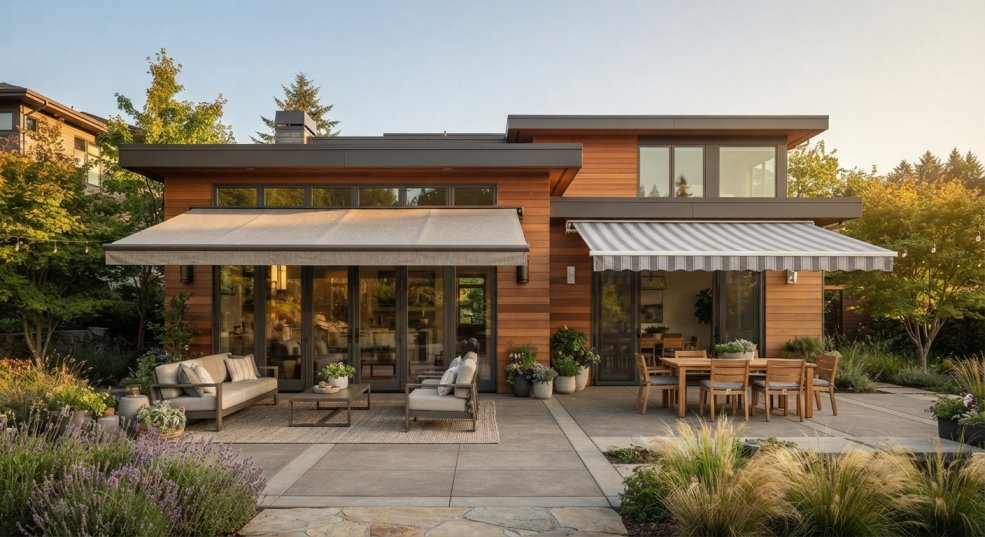
Custom awnings provide more opportunity to coordinate the design with your home’s architectural style. The right size, material, colour, and configuration can make the awning feel like part of the property rather than something added later.
This can also contribute to curb appeal. A well-proportioned awning can add visual interest while serving a practical purpose.
Prefabricated products can still look attractive, particularly when the available design suits the home’s exterior. However, homeowners with a distinctive architectural style may appreciate the additional flexibility that custom-made awnings offer.
Custom and Prefabricated Awnings for Sun and Weather Protection
The main reason many homeowners install an awning is to create comfortable outdoor shade. But the amount and type of protection you need depends on your home’s climate and sun exposure.
Consider when direct sunlight reaches the patio, deck, windows, or doors. The angle of the sun changes throughout the day and across the seasons, so simply choosing the largest available awning isn’t necessarily the best approach.
A properly selected awning can help reduce direct sun exposure and make outdoor areas more comfortable. Depending on the design and material, awnings can also provide a degree of weather protection.
For homes in the Okanagan, where sunny conditions are an important consideration during warmer months, planning the coverage around the property’s actual exposure can be particularly useful.
Retractable vs Fixed Awnings: What’s the Difference?
It’s important not to confuse two different comparisons: custom vs prefabricated and retractable vs fixed.
A retractable awning gives you the ability to extend the shade when you want it and retract it when you don’t. This can be useful when you want flexibility based on changing sunlight or weather conditions.
A fixed awning, on the other hand, remains in place and provides consistent coverage. It can be appropriate for windows, entrances, or outdoor areas where permanent shade is preferred.
There are also modular awnings, which offer a more structured approach to creating shade while providing some configuration flexibility.
A retractable awning can be custom-made, and a fixed awning can be prefabricated. These categories aren’t mutually exclusive, so think about both the product type and whether you need customization.
What About Fabric, Aluminum, and Metal Awnings?
Material selection can influence appearance, maintenance, durability, and suitability for the location.
Fabric awnings can offer a softer appearance and work well when design and outdoor comfort are priorities. They’re often associated with patios and other outdoor living spaces.
Aluminum awnings offer a different look and can be a practical consideration where durability and maintenance are important factors.
Metal awnings can provide a strong, durable solution, although the appropriate material depends on the application, design, and level of exposure.
Rather than asking which material is universally best, consider how the awning will be used, how much weather it will encounter, how you want it to look, and what level of maintenance you’re comfortable with.
Installation and Maintenance Considerations
Installation is another area where custom and prefabricated products can differ.
A custom awning requires careful attention to measurements, mounting location, configuration, and the structure where it will be installed. Proper installation is essential to achieving the intended fit and performance.
Prefabricated awnings may have more standardized installation requirements, particularly when the product is designed for a straightforward application.
Maintenance requirements will depend on the awning type and material. Keeping the system clean, checking components periodically, and following the manufacturer’s care recommendations can help support durability and longevity.
Quality materials and proper installation also matter. The cheapest option isn’t necessarily the best value if it doesn’t perform well in the conditions your home experiences.
Which Is Better for Your Budget?
Cost is naturally part of the decision.
Prefabricated awnings can have a lower initial price because they’re manufactured around standard sizes and configurations. This makes them attractive when the available product already meets your requirements.
Custom awnings may require a greater upfront investment because they’re designed around your property. However, the comparison shouldn’t stop at the purchase price.
Consider the long-term value of getting the right size, coverage, appearance, and functionality from the beginning. If a custom solution provides better shade and integrates more effectively with your home, the additional investment may make sense.
The best choice is the one that balances your budget with what you actually need from the awning.
When Should You Choose Custom Awnings?
Custom awnings are worth considering if:
- Your patio, deck, windows, or doors have unusual dimensions.
- You need a precise fit or specific coverage.
- Your home has distinctive architectural features.
- You want greater control over appearance and configuration.
- Sun exposure varies significantly across the area you’re trying to shade.
- You plan to use the space regularly as an outdoor living area.
- Long-term value matters more than simply choosing the lowest initial price.
When Are Prefabricated Awnings a Better Choice?
A prefabricated awning may be the right option when your requirements are straightforward. If a standard-size product fits the available space, provides enough outdoor shade, complements your home, and stays within your budget, customization may not be necessary.
For some homeowners, simplicity is the biggest advantage. There’s no need to customize a product simply for the sake of customization when an existing solution already does the job.
Which Awning Is Better for Your Home?
For homeowners who need a precise fit, greater design flexibility, or coverage tailored to their property’s specific dimensions, custom awnings are generally the more versatile choice. They can be particularly valuable when working with unusual spaces or when appearance and long-term value are priorities.
Prefabricated awnings make sense when a standard product fits your home and meets your expectations for shade, appearance, and budget.
Ultimately, the right choice comes down to your property, not simply the label on the product.
How to Choose the Right Awning
Start by identifying exactly where you need shade. Measure the area and consider the position of windows, doors, patios, decks, and outdoor furniture. Then think about your home’s sun exposure and the type of weather protection you want.
Next, consider whether a retractable, fixed, or modular system makes sense. Look at available materials, maintenance requirements, architectural style, and expected durability. Finally, compare the total cost against the value you’ll receive over time.
If you’re unsure whether a standard product will work, professional advice can help you understand your options before you invest.
Find the Right Shade Solution for Your Home
Choosing between custom and prefabricated awnings doesn’t have to be complicated. The key is matching the product to your home’s dimensions, outdoor space, sun exposure, design, and budget. A well-planned awning should provide useful shade while complementing the property for years to come. For homeowners in Kelowna and the surrounding Okanagan area, Shutters and Shade can help you explore practical awning solutions tailored to your home and outdoor living needs.