How to Choose the Right Mesh for Your Retractable Screen Needs
Choosing the right mesh for a retractable screen is about more than keeping bugs outside. The mesh you select can affect airflow, privacy, outdoor views, UV protection, heat, and durability. Some homeowners need basic insect protection, while others want to reduce glare or make a patio more comfortable in direct sun. Understanding the differences between mesh materials and designs makes it much easier to choose a screen that suits your home and lifestyle.
Why Does the Right Retractable Screen Mesh Matter?
The mesh is the part of a retractable screen that does most of the practical work. It creates a barrier between your indoor or outdoor living space and unwanted insects while still allowing air and, depending on the material, sunlight and views to pass through.
However, different screen mesh options are designed with different priorities in mind.
For example, a standard fiberglass mesh may be ideal if your main concern is mosquitoes and flies. A solar screen mesh may be more suitable for a sunny patio where heat and glare are bigger concerns. If you have pets, you may want a stronger pet-resistant mesh that can withstand more everyday wear.
The goal is not to find one mesh that is “best” for everyone. It is to find the mesh that performs well for the way you actually use the space.
What Are the Main Types of Screen Mesh?
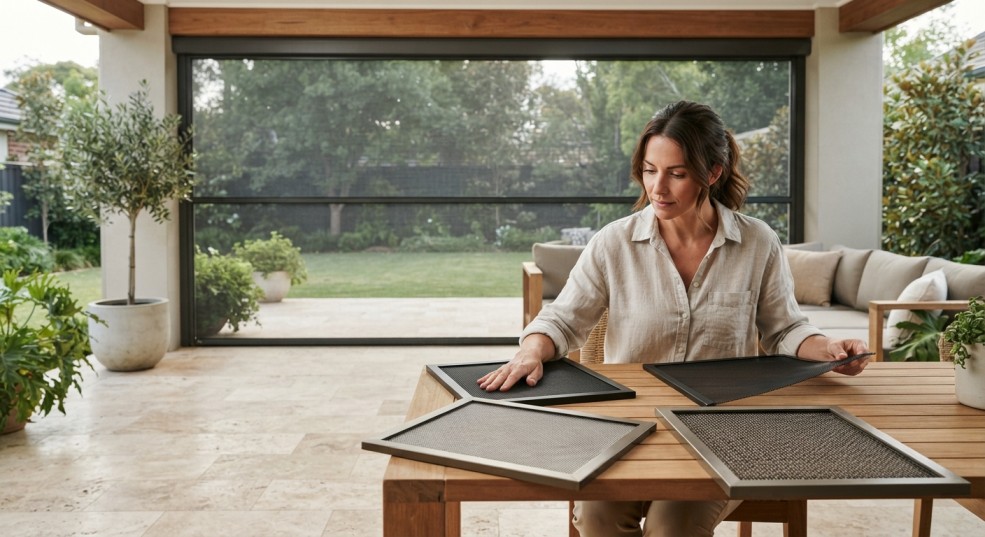
There are several types of mesh used in retractable screen systems, and each has its own strengths.
Fiberglass Mesh and Fiberglass Screen
Fiberglass mesh is a common choice for residential screening. It is lightweight, flexible, and well suited to everyday insect protection.
A standard fiberglass screen can provide a good balance between airflow, visibility, and protection from common insects. If you want to open a patio door or window to enjoy fresh air without inviting mosquitoes and flies inside, this type of mesh can be a practical solution.
It is particularly useful when solar control or heavy-duty durability is not your primary concern.
Solar Screen Mesh
Solar screen mesh, sometimes simply called solar mesh, is designed with sunlight control in mind.
This type of screen can help reduce the amount of direct sunlight entering a space, which may make a sunny patio, deck, or room more comfortable. Depending on the specific mesh, it can also help with UV protection, solar heat gain, and glare reduction.
Solar mesh can be a strong option for large openings that receive intense afternoon sun, especially when you want to spend more time outdoors without sitting directly in harsh sunlight.
Privacy Screen Mesh
If your patio or outdoor living area is visible to neighbours, privacy screen mesh may be worth considering.
Privacy-oriented mesh generally has a denser construction that limits visibility through the screen. It can create a more secluded feeling without completely closing off the space.
There is an important trade-off, though. The denser the mesh, the more it can affect visibility and airflow. A privacy-focused solution should therefore be chosen with the location and desired level of ventilation in mind.
No-See-Um Mesh
Standard insect mesh is effective against many common pests, but some homeowners need protection from much smaller insects.
No-see-um mesh has a finer opening designed to help keep tiny flying insects outside. It can be useful in areas where smaller pests are particularly troublesome.
Because the openings are finer, however, it is worth considering how much airflow and visibility you want. More insect protection is not necessarily the same thing as more ventilation.
Pet-Resistant Mesh
Homes with dogs and cats may require a different approach.
Pet-resistant mesh is designed to handle more physical contact than conventional screening. One common material is vinyl-coated polyester, which offers greater resistance to scratching, pushing, and tearing.
This can make it a useful choice for patio doors and other openings where pets frequently move between indoor and outdoor areas.
Pet-resistant does not mean pet-proof, so good habits and proper screen operation still matter. But for a high-use doorway, stronger mesh can provide an added level of durability.
Aluminum Mesh and Stainless Steel Mesh
Aluminum mesh and stainless steel mesh can provide additional strength for certain applications.
Metal mesh may be considered where resistance to physical damage is a priority. Stainless steel, in particular, is known for its strength and corrosion resistance.
However, mesh material must be compatible with the retractable screen system. Not every mesh is appropriate for every mechanism, so it is important to look beyond the material itself when making a decision.
How Does Mesh Density Affect Performance?
One of the most important concepts to understand is mesh density.
Mesh density refers broadly to how closely the strands are woven together and how large the resulting openings are. Weave density influences several aspects of screen performance, including insect protection, airflow, visibility, and privacy.
A tighter weave can provide better protection against smaller insects and may offer greater privacy. On the other hand, a more open design can allow more air and light through.
That means choosing a dense mesh simply because it sounds more protective may not be the right decision for a homeowner who values a strong breeze and clear outdoor views.
What Is Mesh Openness or Openness Factor?
The mesh openness / openness factor describes how much of the screen consists of open space compared with the material itself.
A higher openness factor generally means more open space between the strands. This can help maintain airflow, natural ventilation, and visibility.
A lower openness factor generally means a denser screen. This can be useful when insect protection, privacy, or solar control is more important.
Think of it as a balancing act. Your ideal screen should provide enough protection without unnecessarily compromising the qualities you enjoy most about your outdoor space.
How Do You Choose Mesh for Insect Protection?
For many homeowners, insect protection is the primary reason for installing a retractable screen.
If the main problem is common pests such as mosquitoes and flies, standard insect mesh may be sufficient. It provides a barrier while allowing air to move through the opening.
If very small insects are a concern, no-see-um mesh may offer better protection.
The important thing is to consider the actual insect problem rather than automatically choosing the finest mesh available. A very dense mesh can influence airflow and visibility, so the most protective option may not provide the best overall experience.
What Mesh Is Best for Sun and Heat?
If your outdoor space receives a lot of direct sunlight, solar control deserves attention.
A solar screen mesh can help reduce exposure to sunlight and may lessen solar heat gain through a screened opening. This can be particularly useful around patios, decks, large windows, and outdoor living areas.
Solar mesh can also provide UV protection, helping reduce the amount of ultraviolet radiation reaching the space behind the screen.
Another benefit is glare reduction. If bright afternoon sunlight makes it uncomfortable to sit on your patio or makes nearby windows difficult to look through, a solar-oriented mesh can make the space more enjoyable.
How Does Mesh Affect Airflow and Natural Ventilation?
One of the biggest benefits of screening a doorway or patio is being able to enjoy fresh air without dealing with insects.
The mesh you choose can affect airflow and natural ventilation.
More open mesh generally allows air to pass through more freely. Dense mesh can restrict airflow to some degree, particularly when compared with an opening that has no screen at all.
If ventilation is one of your top priorities, pay close attention to the mesh’s openness rather than focusing only on how fine the weave is.
For a breezy patio, a balanced mesh can help you enjoy outdoor air while still maintaining useful insect protection.
How Does Mesh Affect Visibility and Outdoor Views?
A retractable screen should not make you feel like you are looking through a wall.
Visibility / outdoor views are especially important when a doorway faces a garden, pool, mountain view, or landscaped backyard. The mesh material, colour, density, and openness can all influence how noticeable the screen is.
If preserving your view is a priority, a suitable higher-openness mesh may be preferable.
Retractable systems offer another advantage: when the screen is no longer needed, it can be retracted completely. This gives you the option of enjoying a fully open view rather than having mesh permanently covering the opening.
Which Mesh Is Best for Privacy?
Privacy is a different goal from visibility.
If your patio faces a neighbouring property or a busy street, a privacy screen mesh can help make the area feel more secluded. A denser mesh can limit what people outside can see through the screen.
The trade-off is that increased privacy can reduce outward visibility and may slightly affect airflow.
Before choosing a privacy mesh, consider which direction you want privacy from and how important your own view of the outdoors is.
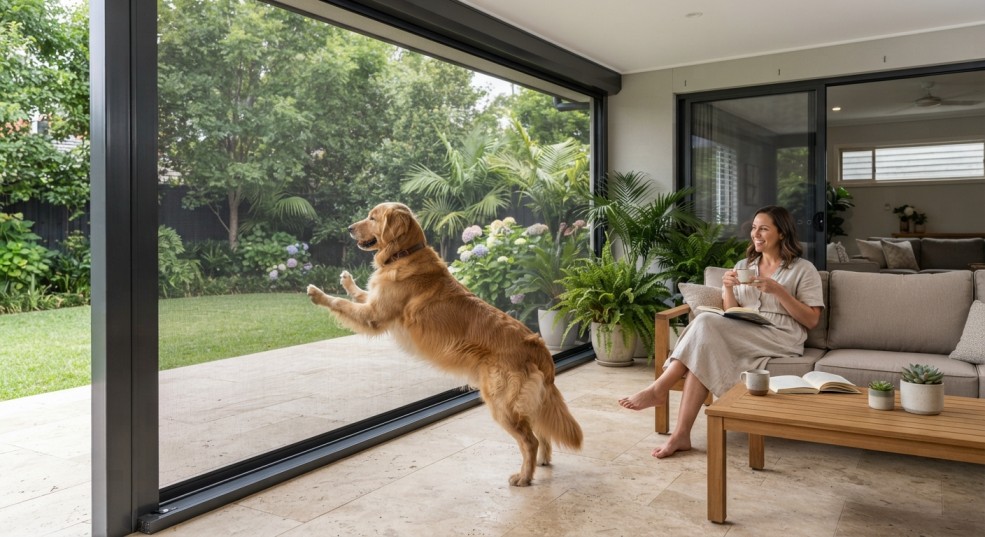
Which Mesh Is Best for Homes With Pets?
If your dog or cat has access to a screened patio or frequently uses a screened doorway, durability becomes more important.
Pet-resistant mesh made from materials such as vinyl-coated polyester can be better suited to repeated contact than standard fiberglass.
Consider where your pet is most likely to interact with the screen. A frequently used patio door may benefit from stronger mesh, while a window that your pets cannot reach may not require it.
How Important Are Weather Resistance and Durability?
Outdoor screens face more than insects. Depending on the installation, they may be exposed to sunlight, wind, rain, temperature changes, and frequent operation.
This makes weather resistance / durability important when choosing mesh.
A durable mesh should be appropriate for the level of exposure and use it will receive. Material quality matters, but so does the overall retractable screen system. The frame, housing, tracks, hardware, and installation all contribute to long-term performance.
A screen that is rarely used may have very different durability requirements from one that is operated several times every day.
How Should You Choose Mesh for Different Areas of Your Home?
The best mesh often becomes easier to identify once you consider the space where it will be installed.
For a patio or deck, insect protection, airflow, visibility, and sun exposure are usually important. Standard fiberglass mesh may work well when insects are the main concern, while solar mesh can make more sense in a particularly sunny location.
For a large patio door, you may want a balance between durability, clear views, and insect protection.
For a sunny outdoor living area, solar screen mesh can help address UV exposure, glare, and solar heat gain.
For a home with pets, pet-resistant mesh may provide greater peace of mind.
And if your area has persistent tiny flying insects, no-see-um mesh may be worth considering.
Should You Choose Mesh Based on Your Climate?
Your local climate should also influence your decision.
Think about how much direct sun your screen receives, how exposed the opening is to wind and rain, and how frequently you will use the screen throughout the year.
For homes in the Okanagan, for example, strong summer sun can make solar control an important consideration, while warm-weather outdoor living makes airflow and insect protection equally valuable. Rather than choosing mesh based on a single feature, consider how the screen will perform across the seasons.
Why Professional Installation Matters
Choosing the right mesh is only half the job. It also needs to be installed correctly.
Accurate measurements help ensure that the screen fits the opening properly. The mesh also needs to be compatible with the retractable mechanism, housing, and tracks.
Professional installation can help identify whether a particular mesh is appropriate for the opening and how it will be used. This is particularly important for large doors, unusual openings, and custom-fit screens.
A properly installed system should retract smoothly, sit correctly when deployed, and provide consistent coverage across the opening.
What Is the Best Mesh for Your Retractable Screen?
There is no universal answer because different homes have different priorities.
If everyday insect protection is your main goal, fiberglass or standard insect mesh may be sufficient. If smaller insects are a problem, no-see-um mesh could be a better fit. For sunny patios, solar screen mesh can help with UV protection, glare, and solar heat gain. Homes with pets may benefit from pet-resistant mesh, while privacy-focused areas may call for a denser privacy mesh.
The best choice is the one that balances protection with the amount of airflow, visibility, privacy, and durability you want.
Frequently Asked Questions
What is the best mesh for retractable screens?
The best mesh depends on your priorities. Fiberglass is a practical general-purpose option, while solar mesh, privacy mesh, no-see-um mesh, and pet-resistant mesh are better suited to specific needs.
Is fiberglass mesh good for retractable screens?
Yes. Fiberglass mesh can provide effective insect protection while maintaining good airflow and visibility, making it a popular residential option.
Is solar screen mesh worth it?
It can be, particularly for areas exposed to strong sunlight. Solar mesh can help reduce UV exposure, solar heat gain, and glare while making the space more comfortable.
What is the difference between solar mesh and insect mesh?
Insect mesh primarily focuses on keeping pests outside while maintaining ventilation. Solar mesh is designed to provide additional sun control, including reduced glare and solar heat gain.
Is no-see-um mesh better than standard screen mesh?
Not necessarily better for every situation. No-see-um mesh provides finer insect protection, but the tighter construction can affect airflow and visibility.
What is pet-resistant mesh made from?
Pet-resistant mesh is commonly made from durable materials such as vinyl-coated polyester. It is designed to resist scratching and tearing better than standard screening.
Does thicker mesh reduce airflow?
A denser mesh can reduce airflow compared with a more open mesh. The openness factor and weave density should therefore be considered if ventilation is a major priority.
Can retractable screens provide privacy?
Yes. A suitable privacy screen mesh can reduce visibility through the screen, although increased privacy may come with reduced outdoor visibility and airflow.
How long does retractable screen mesh last?
The lifespan varies according to mesh material, weather exposure, frequency of use, maintenance, installation quality, and the overall screen system.
Bottom Line
The right retractable screen mesh should match the way you use your home. Start by deciding whether your biggest priority is insect protection, airflow, sun control, privacy, visibility, pet resistance, or long-term durability. From fiberglass and solar mesh to no-see-um and pet-resistant options, each has a specific role. A professional can also help match the mesh to your opening and install a custom-fit system that performs reliably for years.